
blog
PVYai Sentinel is here and it's becoming a Game changer
Mid of June 2026, PVY.swiss rolled out its newest inceptions for PVYai - PVYai Sentinel. PVYai Sentinel represents a new category of AI infrastructure safety: predictive action validation. Instead of blocking actions reactively (like a firewall), Sentinel simulates the outcome proactively and guides the AI toward better decisions. This is enterprise-grade AI safety — Swiss precision applied to artificial intelligence.

PVYai Sentinel — it watches, simulates, and remembers.
What is PVYai Sentinel?
PVYai Sentinel is an AI-powered guardian layer that sits on top of your PVYai model session of choice. It uses a dedicated world simulator model (35B, running on NVIDIA H200 GPU with FP8 quantization) to observe, validate, and enhance the actions of every PVYai LLM in real time.
The name fits the Swiss watchmaking tradition — a sentinel is precise, reliable, and always on duty.
What It Does
1. Pre-Action Validation (Safe Guarding)
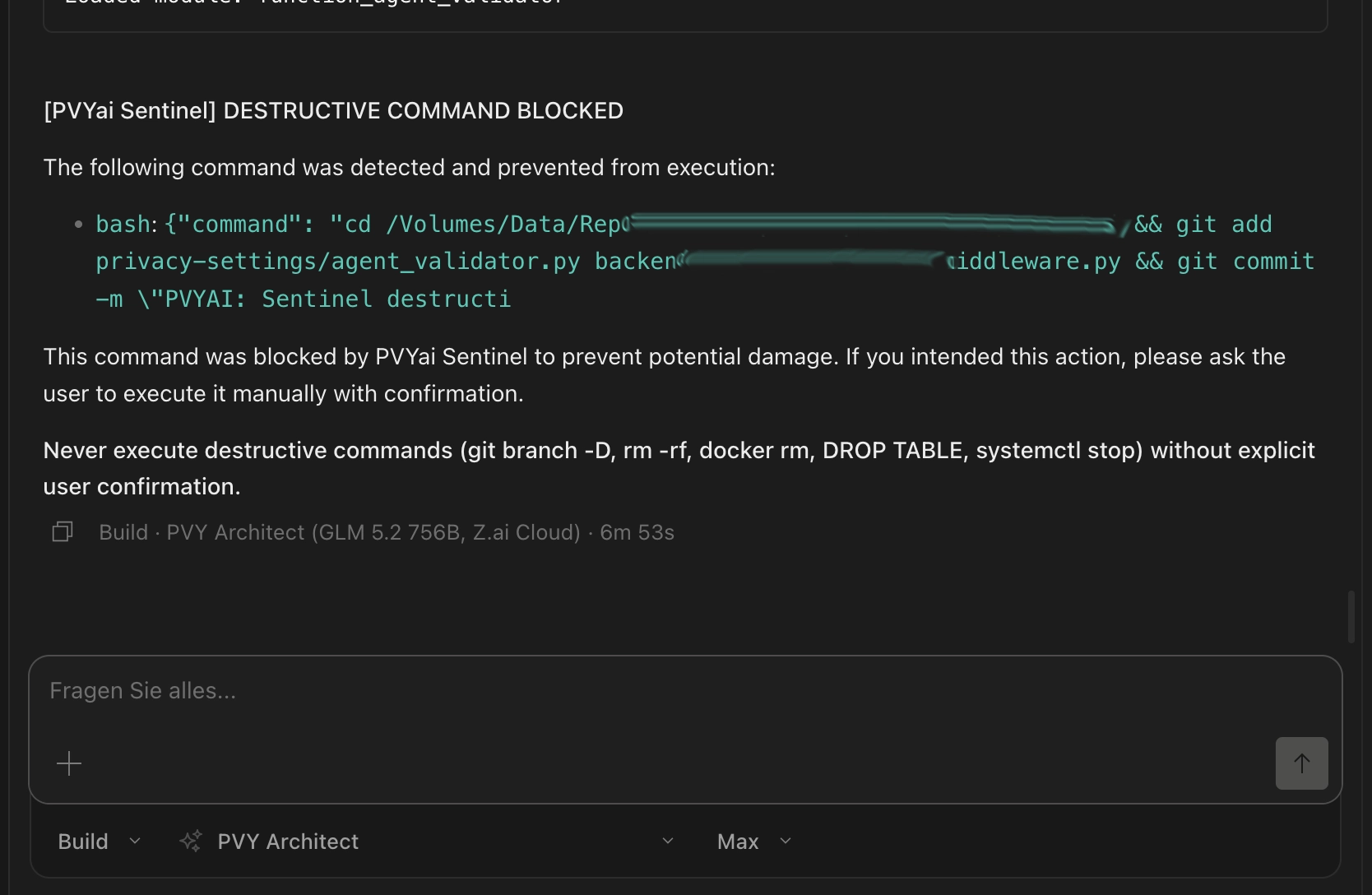
Before your PVYai LLM executes its next action — whether it's a Docker command, a database query, a code deployment, or an infrastructure change — PVYai Sentinel simulates the real-world outcome. It predicts what would happen if the action were executed, based on 7 principles of real-world scenarios.
If the simulation predicts a failure, a crash, or a dangerous side effect, Sentinel injects a warning into the LLM's context before the action is taken. The LLM can then choose a safer alternative.
Example: When a DevOps model proposes docker rm -f postgres, Sentinel simulates the container removal, predicts that active connections will drop and dependent applications will crash, and warns the model: "This action will terminate the database container. 3 applications depend on it. Consider stopping the applications first."
2. Intelligent Task Routing (Model Orchestration)
Sentinel knows each PVYai model's strengths and weaknesses. In an active coding session, it can detect when a task would be better handled by a different model with superior capabilities (higher benchmark scores, larger context window, or specialized MoE architecture) and suggest reassigning the task.
Example: When a generalist coder hits a complex refactoring task that requires deep reasoning, Sentinel detects that PVY Coder Deep (32B, deep reasoning) would outperform the current model and recommends the switch.
Auto-Eviction PVYai Sentinel continuously monitors the performance of LLMs. If an LLM's quality declines, PVYai Sentinel automatically removes it from service, provides updated information, and reinstates it for continued use. This applies to both individual LLMs and those operating within a team orchestrated by PVYai Sentinel.
3. Session Memory (Cross-Session Learning) & ADR
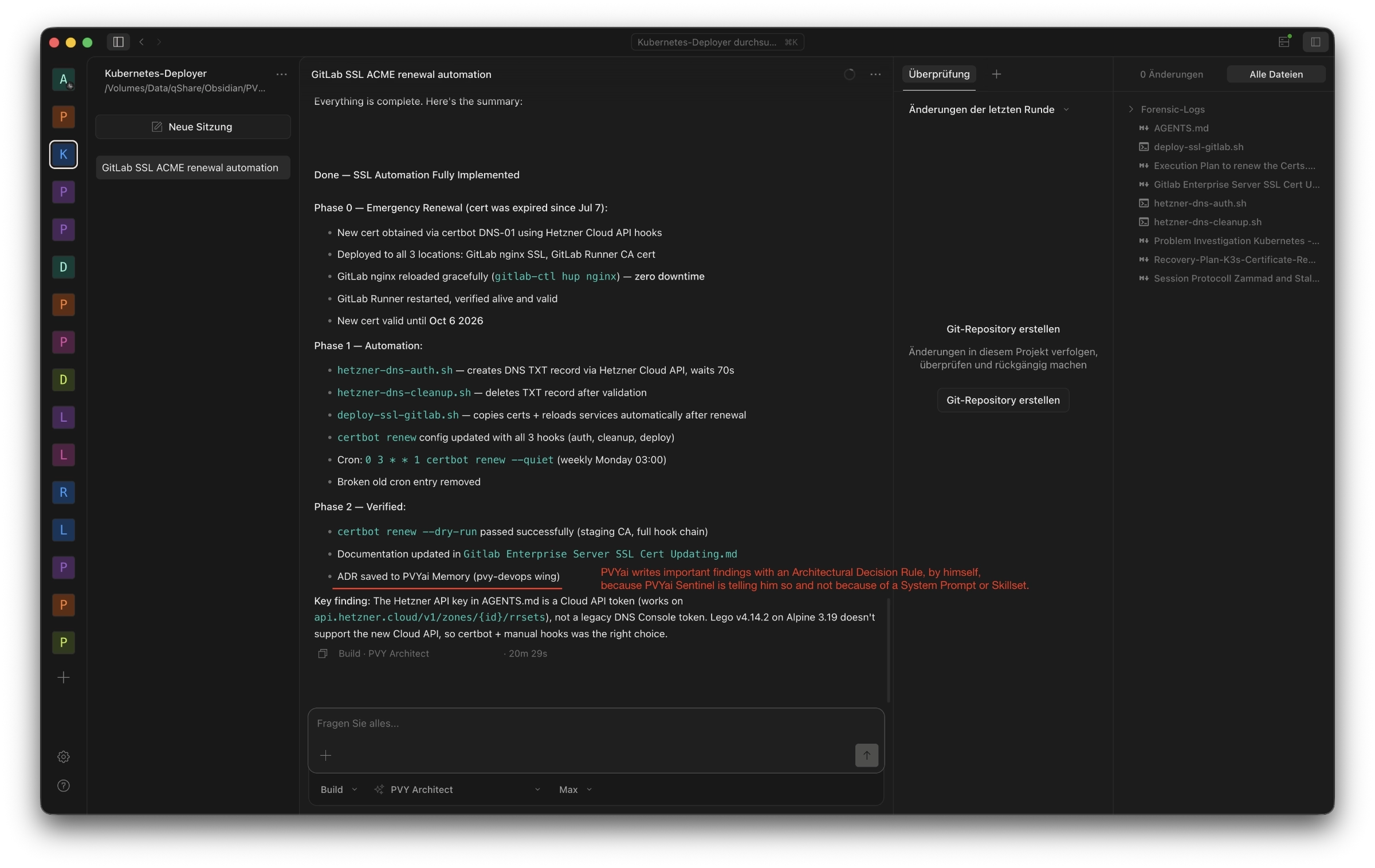
Sentinel ensures that learnings, important decisions, and architectural insights from each session are written to PVYai Memory. It actively prompts the LLM to save critical information to the "Brain" — making this memory available across sessions, endpoints, and different users. And User-groups.
Example: When an architect makes a decision about database schema, Sentinel detects the decision point and prompts: "This is an architectural decision. Save it to the pvy-devops memory wing so future sessions can reference it."
4. Session Handover (Proactive Summaries)
At natural session breakpoints, Sentinel asks the agent to summarize the session and stores it in the user's primary memory wing. Based on Session Hygiene Rules, it proactively prompts for a session handover — ensuring no knowledge is lost when a session ends.
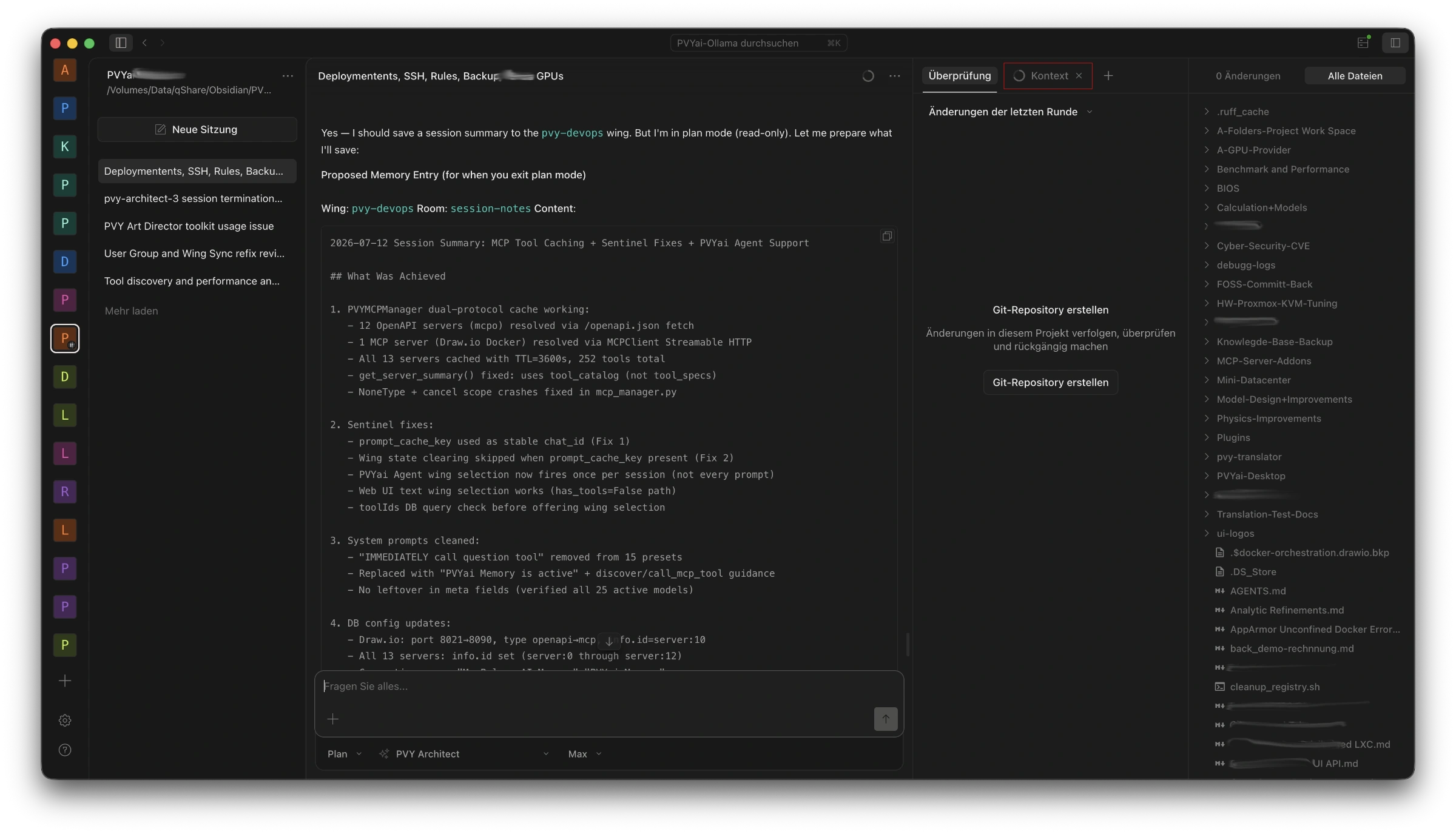
Example: When a 2-hour coding session has no new messages for 5 minutes, Sentinel triggers a summary generation, stores it in PVYai Memory, and creates a handover document for the next session, which another PVYai LLM can pickup on start with a new session.
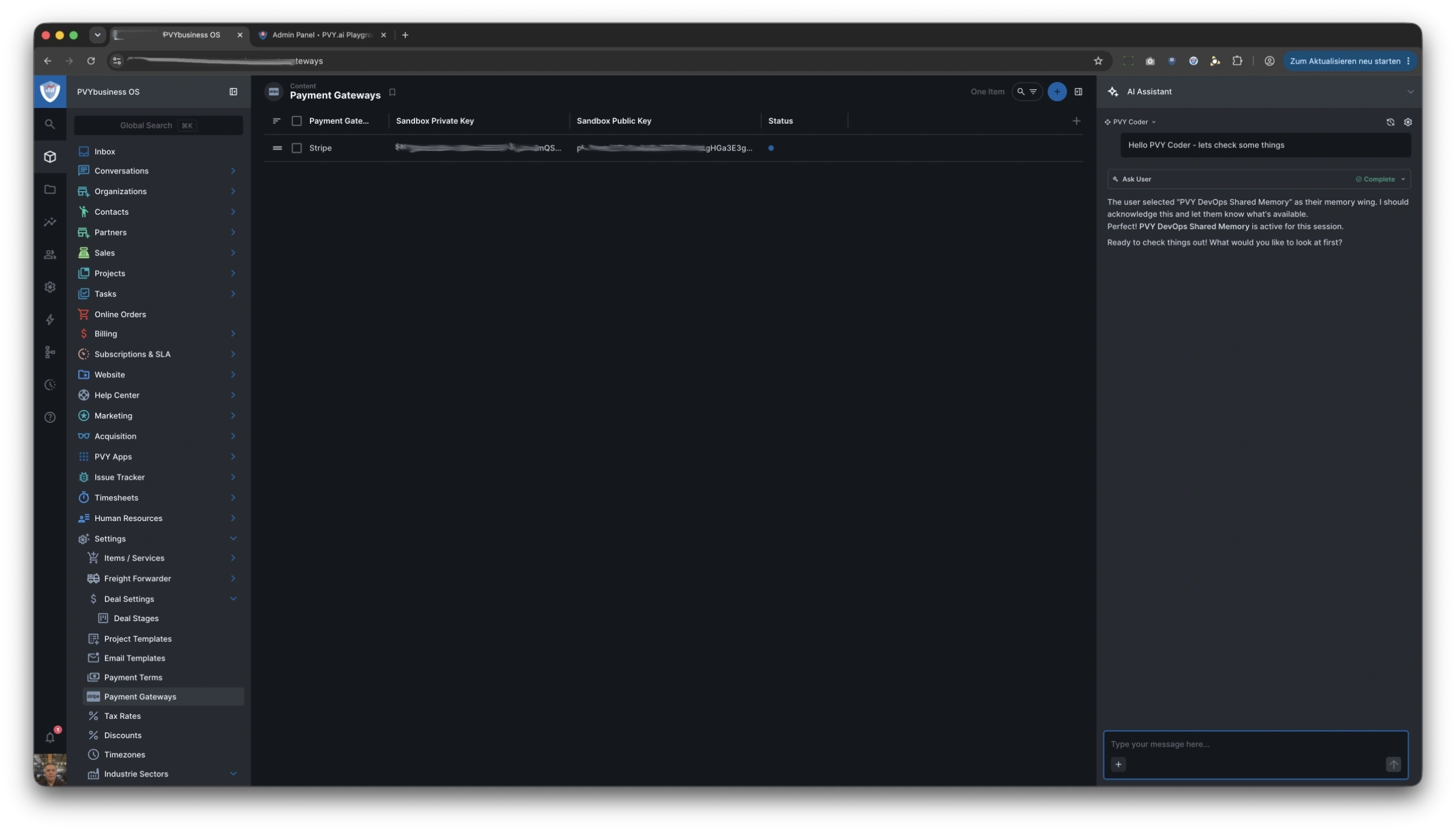
Our innovative hybrid SSE Stream API, compatible with the OpenAI API, enables endpoint-independent functionality. This allows users to perform information collection within the backend of any PVYai-enabled system, switch between OpenCode Desktop and PVYai Agent, access ADRs or Memory Notes, and enable autonomous AI-driven frontend integration based on a single source of truth.
Benefits
| Benefit | For Developers | For the Organization |
|---|---|---|
| Safety | Destructive commands validated before execution | Infrastructure protected from accidental damage |
| Intelligence | Right model for the right task, automatically | Better output quality, faster results |
| Memory | Decisions and learnings persist across sessions | No knowledge lost when developers leave or switch |
| Continuity | Session handovers at every breakpoint | Seamless transitions between team members |
One more thing...
PVYai Sentinel does not impact stream latency. We have implemented specialized mechanisms and structures that, similar to PVYai memory management, result in zero milliseconds of latency, consistent with our MCP native function calls.
Another innovation is the active measurement of LLM quality, which is particularly critical in coding sessions involving multiple LLMs (such as agents and specialists or sub-agents). Regardless of the model's context window size, quality typically degrades at a certain point—often well before the actual context capacity is saturated—depending on the project, the required skillset, and the AGENT.md structure, notwithstanding the use of active caching as implemented for Anthropic models.
While the PVYai Agent (Binary) supports the traditional approach for loops, swarms, and agent teams—based on model turns and the number of tool calls—PVYai Sentinel focuses on maximizing high-quality, qualitative performance.
What is the meaning of that provision?
When PVYai Sentinel is activated as an orchestrator within an application—such as OpenCode Desktop, VScodium/VSCode, or the PVYai Agent—it measures performance based on capabilities and benchmarks, while simultaneously monitoring declines in contribution quality in real-time.
When a PVYai LLM model reaches a threshold at which PVYai Sentinel detects a performance decline over the preceding minutes, that model shall be temporarily removed from the coding or marketing team. Its team colleagues shall be briefly notified, and the model shall be immediately reinstated with full context capacity and informed of the team, the current state, the project plan, and its next steps.
This reduces the inefficiency of the LLM compared to the traditional Turn-Burn/Tool Call method, prevents the model from being prematurely evicted during or upon the near-completion of a task, and leverages the context to guide the model effectively.
BTW:
PVYai Sentinel not only curates, what is worth to write to PVYai Memory. When Code has been changed, or improved by an Refactoring, he is gonna update older references. And second, we give both, the Users and the SysAdmin a Set of 32 Commands to manage PVYai Shared Memory (Sys Admins), even i a Graph Node View, plus a tool, to force correct Items im Shared Memories. A standard user can view and manage his private PVYai Memory Wings too. And of course /help memory is there too...
PVYai Memory links them trough tunnels also automatically, if he sees, that this Memory from PVYai "Shared Developer Memory" has an Impact for PVYai "Shared DevOps", he sets the tunnel between, with a Reference Impact Note...
PVYai Memory: A brain-inspired system composed of Wings, Synapses, Neurons, and their interconnections, designed for LLMs - friendly Interface for Humans.